Showing posts with label Chapter 11. Show all posts
Saturday, 9 March 2013
Simailarity and difference between Hinge Joint (S) and Ball and Socket (T)
Similarities:
F1 Both Joint S and Joint T has a cavity filled with svnovial fluid // lined with synovial membrane
El Synovial fluid acts as lubricant to reduce friction between bones // absorbs shock of the movement.
F2 The end surfaces of the humerus bone of Joint S and Joint T are covered with cartilage
E2 To protect the bone / reduce friction between the bones
F3 Both Joint S and T are connected with ligaments
E3 to absorb shock // strengthen the articulation of bones/ joint.
Differences:
D1 Joint S is hinge joint
E4 Joint S allows the movement of bones in one plane / direction
D2 Joint T is ball-and-socket joint.
E5 Joint T allows rotational movement of bones in all directions.
Movement in Human
Pl- Tendons, ligaments, bones, muscles and joints are important features in a movement,
P2- Tendons connect muscles to bones
P3- Tendons are strong and non elastic
P4- Force is transferred to bones through tendons.
P5- Movement at the joint is possible with the aid of ligaments.
P6- Ligaments connect two bones together
P7-to give support and strength to the joint.
P8- Ligaments are strong and elastic.
P9- The quadriceps / extensor muscles contract while the biceps femoris muscles relax and the leg is straightened.
P10- The biceps femoris muscles contract while the quadriceps / extensor muscles relax and the leg is bent.
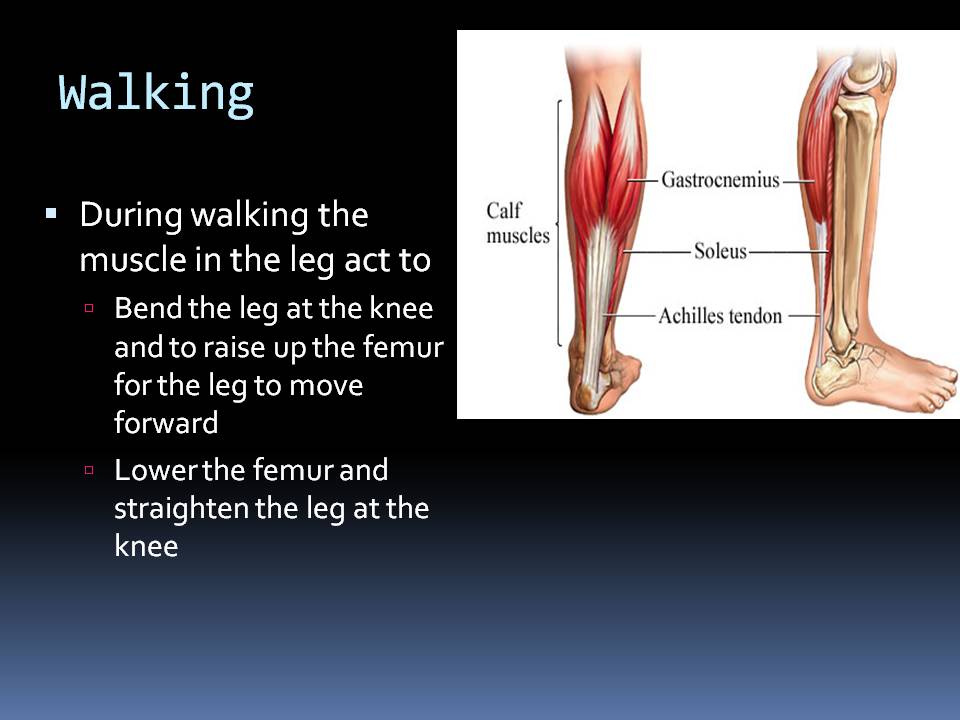
P11- Calf muscles contract to lift up the heels.
P12-Feet push downward and backward
P13-Repeated contraction and relaxation of muscles result in the running movement.
P2- Tendons connect muscles to bones
P3- Tendons are strong and non elastic
P4- Force is transferred to bones through tendons.
P5- Movement at the joint is possible with the aid of ligaments.
P6- Ligaments connect two bones together
P7-to give support and strength to the joint.
P8- Ligaments are strong and elastic.
P9- The quadriceps / extensor muscles contract while the biceps femoris muscles relax and the leg is straightened.
P10- The biceps femoris muscles contract while the quadriceps / extensor muscles relax and the leg is bent.
P11- Calf muscles contract to lift up the heels.
P12-Feet push downward and backward
P13-Repeated contraction and relaxation of muscles result in the running movement.
Hip Replacement - Due to ostreoporosis
Disadvantages of having a hip replacement.
It may cause the surrounding tissue to become inflamed
Painful
Dislocation /blood clot
Risk of infection after surgery
Her legs may not be exactly the same length
The artificial hip will eventually need replacing
Intervertebral disc
Function of Intervertebral Disc
F: permit movement of vertebral column
P: absorb shock / reduce friction
Grasshopper Jumping
A grasshopper has antagonistic muscles called the flexor and extensor muscles which ( are attached to the interior of the exoskeleton)
The rear legs are bigger and longer and (are adapted for jumping).
Flexor muscle contract to flex the leg / prepare for jumping.
Flexor muscle relaxed, extensor muscle contracts.
Causes the rear legs to extend and pushes against the ground
The thrust created propels the grasshopper forwards and upwards.
Movement of Earthworm
Earthworm have a hydrostatic skeleton 1m
The body wall has both longitudinal and circular muscle which
act antagonistically
The contraction of the circular muscle and relaxation of the
longitudinal muscles cause the segment to extend.
Chaetae are extended to grip the soil / ground
The contraction of the longitudinal muscle and relaxation of
the circular muscle cause the segment to shorten.
Contraction and relaxation of these muscles causes the
transfer of hydrostatic pressure from the anterior to the
posterior.
It causes the body to move to the front.
The chaetae are retracted to allow movement
Friday, 8 March 2013
Wednesday, 27 February 2013
Thursday, 8 November 2012
Friday, 4 May 2012
Chapter 11 SPM Paper Year Paper
2005 – Muscles, Tendon, Fish, Human and Earthworm
2007 - vertebrae axial skeleton , lumbar and cervical, thoraic
2009 – Support in Plant 2010 – Bending of arm, Osteoarthritis, Warming Up
2011 – Tendon, Ligament,Muscle Cramp, Healthy Musculoskeletal system
2012 – Walking , Support in Plant, Bird Flying
2007 - vertebrae axial skeleton , lumbar and cervical, thoraic
2009 – Support in Plant 2010 – Bending of arm, Osteoarthritis, Warming Up
2011 – Tendon, Ligament,Muscle Cramp, Healthy Musculoskeletal system
2012 – Walking , Support in Plant, Bird Flying
Tuesday, 24 May 2011
Movement in Fish
Type of Movement
- Move Forward
- Change Direction , Brake or Stop
- Balancing
Fish has a streamllined body shape which allows it to move easily through the water with minimal frictional drag
The body of a fish is covered with scales that overlap one another with the free end pointing backwards to reduced frictional drag in the water.
The movement of fish in water is due to the antagonistic action of the W shaped segmental block of muscles (myotomes ) on both sides of the backbone and the action of its fins
Locomotion in Fish Forward Movement
During swimming, the tails is swept from side to side to bend the body on either side alternately and produce a thrust that propels the fish forward.
The sweeping of the tail is due to the contraction and relaxation of the myotome on either side of the body that work antogonistically against the backbone.
The contraction of the myotome on the right side of the body will bend the tail to the right, while the contraction of myotome on the left side of body will bend the tail to the left.
Locomotion in Fish Balancing body
The function of the fins in fish is to maintain the balance of the body during swimming.
The paired fins consists of the pectoral fins and the pelvic fins
The pectoral fins are used for steering, to change direction and as a brake to slow down or stop the movement
The pelvic fins are used for balance and to keep the fish stead by preventing driving and rolling movements.
The unpaired fins consist of one dorsal find, one ventral and one caudal fin or tail. The tail is the propulsion organ. The other unpaired fins are used for balancing by preventing rocking and rolling movement.
- Move Forward
- Change Direction , Brake or Stop
- Balancing
Fish has a streamllined body shape which allows it to move easily through the water with minimal frictional drag
The body of a fish is covered with scales that overlap one another with the free end pointing backwards to reduced frictional drag in the water.
The movement of fish in water is due to the antagonistic action of the W shaped segmental block of muscles (myotomes ) on both sides of the backbone and the action of its fins
Locomotion in Fish Forward Movement
During swimming, the tails is swept from side to side to bend the body on either side alternately and produce a thrust that propels the fish forward.
The sweeping of the tail is due to the contraction and relaxation of the myotome on either side of the body that work antogonistically against the backbone.
The contraction of the myotome on the right side of the body will bend the tail to the right, while the contraction of myotome on the left side of body will bend the tail to the left.
Locomotion in Fish Balancing body
The function of the fins in fish is to maintain the balance of the body during swimming.
The paired fins consists of the pectoral fins and the pelvic fins
The pectoral fins are used for steering, to change direction and as a brake to slow down or stop the movement
The pelvic fins are used for balance and to keep the fish stead by preventing driving and rolling movements.
The unpaired fins consist of one dorsal find, one ventral and one caudal fin or tail. The tail is the propulsion organ. The other unpaired fins are used for balancing by preventing rocking and rolling movement.
Friday, 15 April 2011
Subscribe to:
Posts (Atom)